
Odoo payroll integration connects a US payroll platform such as ADP, Paychex, Gusto, Rippling, or Paylocity to Odoo so employee records, hours, and pay results move between them without rekeying. Odoo has no US payroll localization, which is why American companies run a dedicated provider alongside it, and why the connection between the two is worth designing rather than improvising.
The honest position is that not every company needs this built. If payroll is one journal entry a month and your headcount is stable, configuration and a disciplined process will serve you better than a project. Where it earns its cost is labor allocation, and we will tell you which side of that line you are on before quoting, as a US-based Odoo integration partner.
Why Your Payroll Platform Needs Odoo Integration
Payroll and operations hold two halves of the same information. Your provider knows what each person was paid. Odoo knows what each person worked on. Keeping those apart costs you in four ways.
Odoo Payroll Does Not Cover US Tax
Odoo ships payroll localizations for several countries, and the United States is not among them. Federal and state withholding, multi-state employees, unemployment insurance, workers compensation codes, and quarterly filings all stay with your provider. Odoo HR holds employee records, time off, and expenses, but the pay run itself happens elsewhere.
Labor Cost Never Reaches the Job
A monthly payroll journal posted as one lump sum tells you what labor cost the company. It does not tell you what it cost to build that order, run that project, or serve that customer. Without allocation, job costing is built on estimated rates rather than what you actually paid.
Employee Records Are Maintained Twice
A new hire is entered in payroll, then again in Odoo. A pay rate changes in one and not the other. A termination is processed by HR and the person keeps an active Odoo login for three weeks. Every divergence is small and every one of them shows up in a report eventually.
Hours Are Rekeyed Every Pay Period
Timesheets, attendance, and work order time sit in Odoo. Someone exports them, reformats them, and enters them into payroll before each cut-off. It is the most error-prone recurring task in most finance departments, and the errors are ones employees notice immediately.
Key Benefits of Odoo Payroll Integration
Connected properly, hours leave Odoo already validated and pay results come back with enough detail to allocate. The value sits in what happens to the numbers after the pay run, not in the pay run itself.
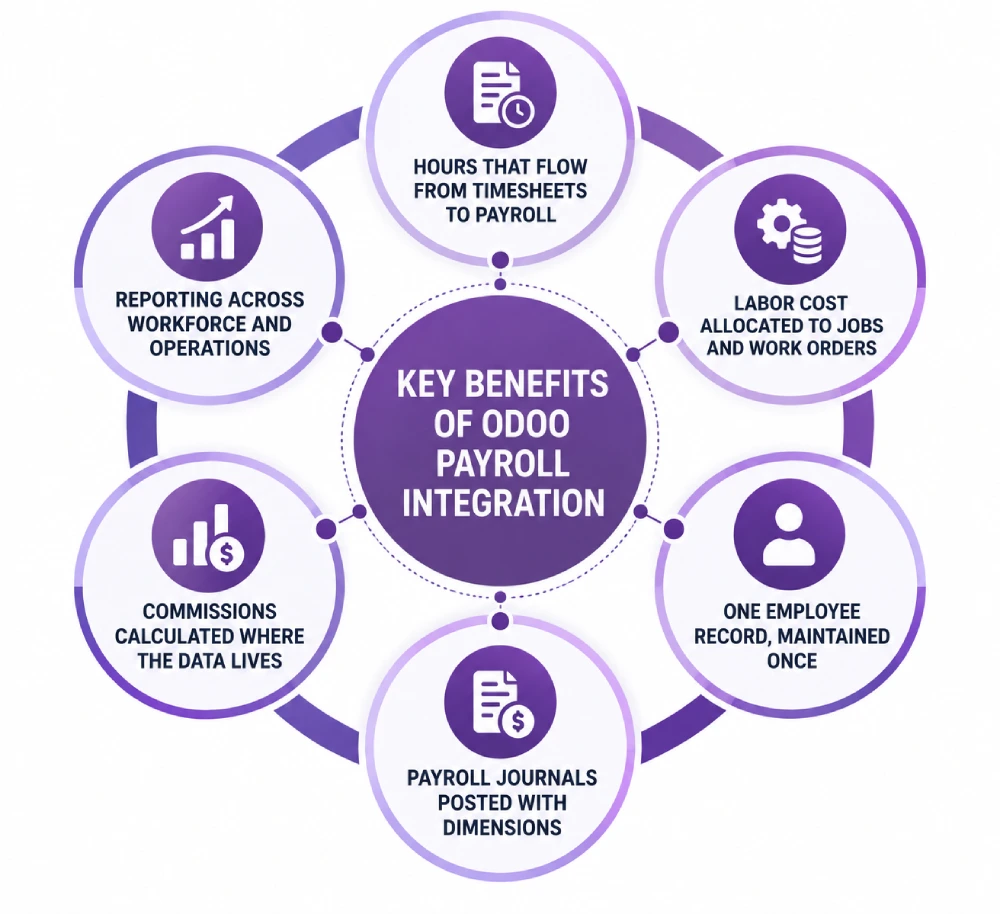
Hours That Flow From Timesheets to Payroll
Approved timesheets, attendance records, and work order time export to your provider in its expected format on your pay schedule. Overtime rules, shift differentials, and PTO come through as configured rather than being adjusted by hand each period.
Labor Cost Allocated to Jobs and Work Orders
Pay results return and post against analytic accounts, projects, and manufacturing orders rather than as a single expense line. Job profitability in Odoo Project and production costing in Odoo Manufacturing then reflect real labor rather than a standard rate.
One Employee Record, Maintained Once
New hires, rate changes, department moves, and terminations sync in the agreed direction so both systems hold the same picture. Onboarding and offboarding become one process instead of two lists someone reconciles quarterly.
Payroll Journals Posted With Dimensions
Gross pay, employer taxes, benefits, and deductions post to the correct accounts split by department, location, or cost centre. Your management reporting shows labor by the dimensions you actually run the business on.
Commissions Calculated Where the Data Lives
Commission based on invoiced sales, margin, or collections is calculated in Odoo against real figures, then pushed as an earning code. The spreadsheet that currently sits between the sales report and the pay run disappears.
Reporting Across Workforce and Operations
Headcount, hours, and labor cost sit alongside output, revenue, and utilisation in one set of reports. Questions about cost per unit or revenue per employee get answered without exporting from two systems and matching names.
What Odoo Payroll Integration Automates
Payroll integrations are judged on what comes back, not what goes out. Sending hours is the easy direction.
| Data object | Direction | Trigger |
| Employee master records | Odoo to payroll | On hire and on change |
| Compensation and rate changes | Both, one master agreed | On approval |
| Departments and cost centres | Odoo to payroll | On change |
| Timesheet and attendance hours | Odoo to payroll | Per pay period, after approval |
| Overtime and shift premiums | Odoo to payroll | With hours, by rule |
| Time off and accruals | Both | On approval and on accrual run |
| Commission and bonus earnings | Odoo to payroll | Per pay period |
| Gross pay and employer taxes | Payroll to Odoo | On pay run completion |
| Payroll journal entry | Payroll to Odoo | On pay run, split by dimension |
| Labor cost allocation | In Odoo | On journal posting |
Some requirements need rules written for your business whichever provider you use. Certified payroll and prevailing wage reporting, union fringe calculations, multi-state withholding for travelling employees, garnishments, workers compensation code mapping, and providers that exchange only by SFTP file all sit outside standard behaviour. They are solvable through custom development, and they are worth raising before you scope rather than after.
How We Integrate Payroll Platforms With Odoo
Your cost depends on the provider and on how far the allocation goes. Pushing hours to a modern REST API is straightforward. Returning pay results split across three hundred analytic accounts is a design exercise, and we establish which you need before quoting.
We Audit Your Payroll Platform and Odoo Setup
Your provider and API access level, headcount and pay frequency, states you employ in, timesheet and attendance sources, existing chart of accounts and analytic structure, union or certified payroll obligations, and your Odoo version and hosting. This is the front end of every Odoo consulting engagement we run.
We Recommend a Route
| Route | Suits | Timeline |
| File exchange by SFTP or CSV | Legacy providers, stable headcount, simple allocation | 3 to 5 weeks |
| Middleware such as Make, Celigo, or a unified payroll API | Modern provider, standard objects, moderate complexity | 4 to 8 weeks |
| Custom API integration | ADP, Paychex, or Gusto direct, with allocation rules | 8 to 14 weeks |
| Custom build with certified payroll or union rules | Construction, prevailing wage, multi-state, union fringe | 12 to 20 weeks |
We Design the Cost Allocation
Which analytic account, project, or work order each hour belongs to, how burden and employer taxes are apportioned, and what happens to time that cannot be allocated. This is the step that determines whether the integration produces useful job costing or a tidier version of the same lump sum.
We Test Against a Live Pay Run
A full period in parallel: hours out, pay results back, journal posted, allocation checked against what your accountant expects. We run it alongside your existing process rather than replacing it, because a payroll error is not a bug your team can absorb quietly.
We Cut Over and Monitor
Cutover timed to a quarter boundary where possible, credentials and employee identifier mappings verified, and alerting on failed exchanges. After that you have ongoing support, because providers change API versions and your pay calendar does not wait.
Odoo Payroll Integration Services From Adatasol
Payroll data is the most sensitive information in your business and the least forgiving of mistakes. An integration that posts late, allocates wrongly, or exposes compensation to the wrong Odoo users creates problems that are difficult to walk back.
You Get a US-Based Odoo Certified Ready Partner
We work from Willoughby, Ohio, on US business hours, under the same federal and state employment rules you operate under. The same team runs your design, build, testing, and support.
We Have Been Doing ERP for 20+ Years
Payroll integration is an accounting problem wearing an HR badge. Two decades of ERP delivery is what tells us how burden should be apportioned and where a labor cost belongs on a job.
We Will Tell You If It Is Not Worth Building
If your payroll is a monthly journal entry and your headcount is stable, an integration will not repay its cost. We say so. The case for building is labor allocation, timesheet volume, or a compliance obligation, and where those are absent we would rather improve your process than sell you a project.
We Handle Job Costing, Not Just Data Transfer
Professional services and manufacturing clients come to us because labor is their largest variable cost and they cannot see it per job. That is the work we scope, as we did for Surveying Consultants, rather than moving records between two systems for the sake of it.
Book a free integration assessment and we will review your provider, your allocation requirements, and your Odoo setup, then tell you which route fits.
Odoo Payroll Integration FAQs
Does Odoo do payroll in the United States?
No. Odoo provides payroll localizations for several countries and the United States is not one of them. US federal and state withholding, filings, and year-end forms stay with a dedicated provider. Odoo holds employee records, time off, expenses, and the accounting side of payroll.
Which payroll platforms integrate with Odoo?
ADP, Paychex, Gusto, Rippling, Paylocity, Paycor, and most modern providers expose APIs that can be integrated. Older platforms often exchange by SFTP file instead. There is no shared payroll standard, so each provider has its own data model, identifiers, and authentication.
Is a payroll integration actually worth it?
Not always. If payroll produces one journal entry a month and your headcount is steady, the integration will cost more than it saves. It pays for itself when timesheet volume is high, when labor must be allocated to jobs or work orders, or when certified payroll and union reporting apply.
Can timesheets flow from Odoo into payroll?
Yes. Approved timesheets, attendance, and work order time export on your pay schedule with overtime and premium rules applied. Approval has to happen before the cut-off, so the integration usually comes with a tightening of your timesheet process rather than replacing it.
How is employee and compensation data protected?
Pay data is restricted through dedicated integration users, Odoo record rules, and field-level access so compensation is not visible to general users. Credentials are stored and rotated properly, and identifiers rather than social security numbers are used as match keys wherever the provider allows.
How much does Odoo payroll integration cost?
File-based exchange with a legacy provider is the cheapest route. Direct API integration with allocation rules costs more, and certified payroll or union fringe work costs considerably more. Cost tracks headcount, pay frequency, and how granular the allocation needs to be.
How long does it take?
Three to five weeks for file exchange. Four to eight weeks through middleware with a modern provider. Eight to fourteen weeks for a direct API build with cost allocation, and longer where prevailing wage or union rules apply.
Which Odoo versions and hosting are supported?
Integrations work across Odoo 16 through 19 on Odoo Online, Odoo.sh, and self-hosted, though custom modules need Odoo.sh or self-hosted. Because payroll touches your chart of accounts and analytic structure, this is worth settling alongside your wider Odoo implementation.