
Odoo payment gateway integration connects processors such as Stripe, PayPal, Authorize.net, and your bank’s ACH service to Odoo so transactions, refunds, chargebacks, and settlement batches record automatically against the correct invoice and account. Odoo ships payment providers for checkout, and the work that matters sits after checkout, in how money arriving in your bank reconciles to the documents in your ledger.
Taking a card on a website is the easy part. What breaks is everything downstream: a $12,400 deposit that represents eleven invoices minus fees, a refund issued in the gateway that Odoo never hears about, and a 3% card fee on a wholesale invoice that should have gone out as ACH. We handle that as a US-based Odoo integration partner.
Why Your Payment Gateway Needs Odoo Integration
Odoo’s built-in payment providers cover website and portal checkout well. They do not, on their own, tell your finance team which deposit paid which invoice or what the payment cost you. That gap shows up in four ways.
Your Deposits Never Match Your Invoices
Gateways settle in batches, net of fees, on their own schedule. One bank line covers several orders minus a percentage and sometimes minus a refund from last week. Someone opens the gateway dashboard next to Odoo Accounting and matches it by hand, every week, forever.
Card Fees Are Eating Your B2B Invoices
A 2.9% card fee on a $40,000 wholesale invoice is $1,160. On ACH it is a flat charge measured in cents. Plenty of US companies run every invoice through the card rail because that is what was configured first, and nobody has routed larger payments to the cheaper method.
Standard Payment Providers Stop at Checkout
The provider modules are built for a customer paying a website order or a portal invoice. Payment against a manually raised invoice, a terminal in your store, a saved card for recurring billing, or an order that originated outside Odoo all need work beyond installing a module and pasting in API keys.
Refunds and Chargebacks Land Nowhere
A refund processed in the gateway dashboard, a disputed transaction, or a partial credit often never reaches Odoo as a document. Your ledger keeps showing revenue that came back out of your account, and the discrepancy surfaces at close.
Key Benefits of Odoo Payment Gateway Integration
Connected properly, every transaction carries a reference that ties it back to an invoice, and every settlement batch resolves into the documents it paid plus the fee it cost. Finance stops reconciling by eye.
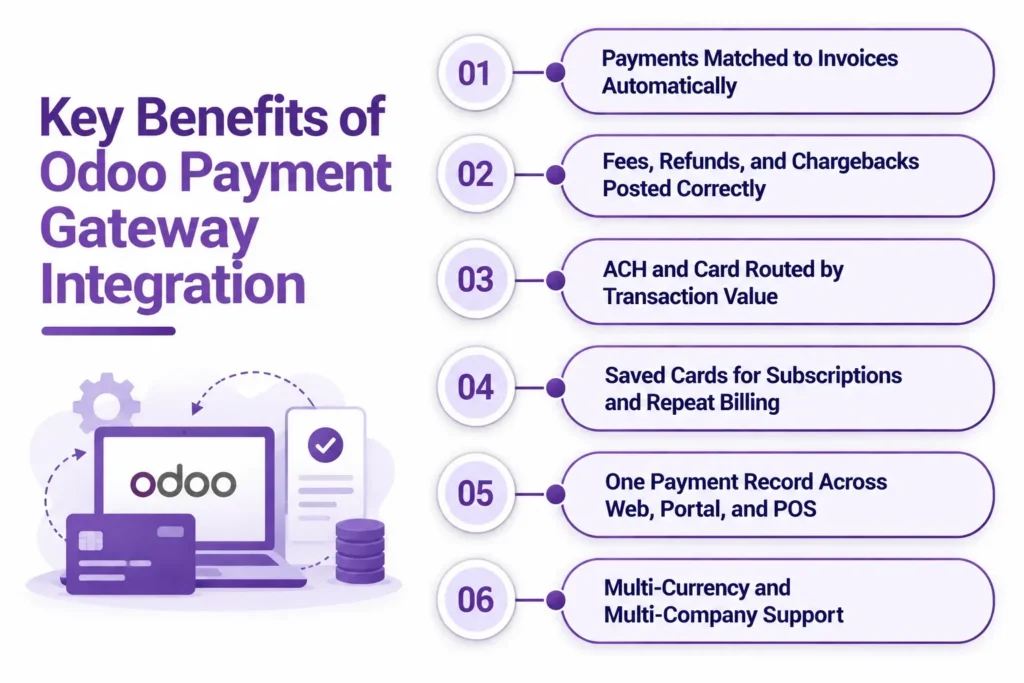
Payments Matched to Invoices Automatically
Authorizations and captures post against the originating sales order or invoice with the gateway’s transaction reference stored on both sides. Any payment can be traced from the bank line to the customer without opening a second system.
Fees, Refunds, and Chargebacks Posted Correctly
Processing fees post to an expense account, refunds create credit notes, and chargebacks record as their own entry rather than as a mystery deduction. Your gross revenue and your net deposits both reconcile because the difference between them is recorded.
ACH and Card Routed by Transaction Value
Small transactions take a card, large invoices route to ACH, and the rule is applied automatically rather than left to whoever raised the invoice. On mid-market volumes this alone tends to cover the cost of the integration.
Saved Cards for Subscriptions and Repeat Billing
Tokenized payment methods let you bill recurring invoices without holding card data yourself. Renewals charge on schedule, failures raise an alert, and retries follow a rule instead of a phone call.
One Payment Record Across Web, Portal, and POS
Website orders, portal invoice payments, and point of sale terminal transactions post into the same accounting structure. A customer paying three different ways still produces one coherent account history.
Multi-Currency and Multi-Company Support
Several merchant accounts map to several Odoo companies, each with its own journals, fee accounts, and settlement currency. Exchange differences post as entries rather than being absorbed into a rounding line nobody questions.
What Odoo Payment Gateway Integration Automates
Checkout is one object out of ten. Your quote should name what happens to the other nine.
| Data object | Direction | Trigger |
| Authorization | Odoo to gateway | At checkout or invoice send |
| Capture | Odoo to gateway | On confirmation or shipment |
| Payment record | Gateway to Odoo | On successful capture |
| Settlement batch | Gateway to Odoo | On payout, scheduled |
| Processing fees | Gateway to Odoo | With settlement, to expense account |
| Refunds | Both | On processing, creates credit note |
| Chargebacks and disputes | Gateway to Odoo | On notification |
| Payment tokens | Gateway to Odoo | On card save, reference only |
| ACH debits and returns | Both | On submission and on return |
| Failed and retried payments | Gateway to Odoo | On failure, with alert |
Some requirements need rules written for your business whichever provider you use. Surcharging, which is regulated differently by state, split payments across multiple methods, deposits and progress billing, held funds and reserve accounts, level 2 and level 3 card data for lower interchange, and gateways with no maintained Odoo module all sit outside standard behaviour. They are solvable through custom development, and unraised scope becomes visible at your first reconciliation.
How We Integrate Payment Gateways With Odoo
Cost is settled in the reconciliation design, not in the connection. Turning on a provider module takes an afternoon. Deciding how a settlement batch resolves into invoices, fees, and refunds is the actual project.
We Audit Your Gateways and Odoo Setup
Your processors and merchant accounts, transaction volume and average value, card versus ACH mix, refund and chargeback rates, entities and currencies, where payments originate, and your Odoo version and hosting. This is the front end of every Odoo consulting engagement we run.
We Recommend a Route
| Route | Suits | Timeline |
| Odoo native payment provider plus configuration | Website and portal checkout, one gateway, one entity | 2 to 4 weeks |
| Provider plus settlement and fee automation | Reconciliation, fees, refunds posted properly | 4 to 8 weeks |
| Custom payment provider module | Gateway with no maintained module, ACH routing, tokenized billing | 8 to 14 weeks |
| Middleware plus custom endpoints | Several gateways and non-Odoo order sources | 10 to 18 weeks |
We Map Payouts to Journals
Each gateway gets a clearing account. Transactions post to it on capture, the settlement batch clears it against the bank, and the difference posts as fees. This is what makes a deposit reconcile in one click instead of by hand, and it is the step most integrations skip.
We Test Against Real Transactions
An authorization and capture, a partial refund, a full refund, a declined card, an expired token, a chargeback, an ACH return, and a settlement batch spanning several days. Gateway sandboxes behave differently from production, so we test against low-value live transactions before go-live.
We Cut Over and Monitor
Cutover timed to a settlement boundary, webhook endpoints verified, alerting on failed captures and returns, and a parallel reconciliation through the first close. After that you have ongoing support, because processors change API versions and webhook contracts without asking.
Odoo Payment Gateway Integration Services From Adatasol
A provider module is free and takes an afternoon. An unreconciled clearing account with eighteen months of unmatched deposits is an audit problem and a cleanup project. We build the reconciliation first and the checkout second.
You Get a US-Based Odoo Certified Ready Partner
We work from Willoughby, Ohio, on US business hours, in the same regulatory environment as your merchant accounts. The same team runs your design, build, testing, and support.
We Have Been Doing ERP for 20+ Years
A payment that posts to the wrong account is an accounting problem. Two decades of ERP delivery is what tells us where the fee, the refund, and the chargeback each belong.
We Tell You If Configuration Is Enough
If Odoo’s native provider covers your checkout and your volume, we configure it and stop there. Custom work gets quoted when routing, tokenization, or reconciliation genuinely needs it, and every requirement is classified before you agree scope.
We Fix Payment Syncs That Are Already Broken
If your clearing account will not clear, refunds are missing, or captures fail silently, that is integration rescue. We reconcile what has already posted before recommending any rebuild.
Book a free integration assessment and we will review your gateways, your volumes, and your Odoo setup, then tell you which route fits.
Odoo Payment Gateway Integration FAQs
Which payment gateways work with Odoo?
Odoo ships providers for Stripe, PayPal, Authorize.net, Adyen, Mollie, Razorpay, and others, with more available through the Apps Store. Gateways without a maintained module connect through a custom provider built on their API. Availability varies by Odoo version, so we confirm against your release before scoping.
How do I integrate a payment gateway with Odoo?
Enable the provider in Odoo, add your API credentials, set the journal and currency, configure the webhook endpoint the gateway calls back to, then test authorization, capture, and refund. Reconciliation and fee posting are configured separately and are where most of the effort sits.
Can Odoo accept ACH payments?
Yes, through processors that support ACH debit, either as a native provider or a custom module. ACH costs a flat fee rather than a percentage, which matters on large B2B invoices, though settlement takes longer and returns can arrive days later and need handling as their own event.
How are gateway fees recorded in Odoo?
Fees post to a dedicated expense account when the settlement batch is reconciled, so gross revenue and net deposits both reconcile. Without this configured, the fee is absorbed into an unexplained difference and your clearing account never balances.
Does Odoo store credit card details?
No. Payment data stays with the gateway and Odoo holds a token referencing the saved method. This keeps card data out of your database and limits your PCI scope, though your hosting, access controls, and internal procedures still form part of your compliance position.
How much does Odoo payment gateway integration cost?
Enabling and configuring a native provider is the cheapest route. Settlement automation, ACH routing, tokenized recurring billing, and gateways without a module cost considerably more. Cost tracks the number of gateways, entities, and reconciliation rules, so we scope before quoting.
How long does it take?
Two to four weeks for one gateway on a native provider with standard checkout. Four to eight weeks with settlement, fee, and refund automation. Eight to fourteen weeks for a custom provider module or ACH routing across multiple entities.
Which Odoo versions and hosting are supported?
Payment providers work across Odoo 16 through 19, where the feature is named payment providers rather than the older payment acquirers. Custom provider modules need Odoo.sh or self-hosted, since Odoo Online does not accept custom code, which is worth settling alongside your wider Odoo implementation.