
Odoo Magento integration connects your Magento 2 or Adobe Commerce store to Odoo ERP so products, orders, customers, stock, and invoices move between the two systems automatically. It runs through a connector module, middleware, or a custom API build, and the work that decides your cost is mapping Magento’s product types, inventory sources, and store hierarchy onto Odoo’s.
Magento is the platform merchants choose when the catalogue is complicated. Configurable products with dozens of variants, bundles, customer group pricing, several websites under one install. All of that flexibility has to land somewhere in Odoo, and a connector configured on defaults will flatten it. We handle that mapping as a US-based Odoo integration partner.
Why Your Magento Store Needs Odoo Integration
Magento runs your catalogue, checkout, and customer experience. Purchasing, stock valuation, costing, and your books sit outside it. You could move the storefront to Odoo eCommerce, though most Magento merchants are on it precisely because they need catalogue depth Odoo does not match. Keep Magento, put Odoo behind it, and the friction shows up in four places.
Your Product Types Do Not Map One to One
Magento has simple, configurable, grouped, bundle, virtual, and downloadable products. Odoo has products with variants, kits, and services. A bundle is not a kit, and a grouped product is not a variant set. Get this wrong at setup and your stock deductions are wrong on every bundle sale from day one.
Inventory Sources and Warehouses Disagree
Magento’s Multi-Source Inventory tracks stock per source with its own salable quantity calculation and reservations. Odoo tracks stock per warehouse and location with its own reservation logic. Two systems, two sets of rules, and neither is wrong. Without deciding which one owns the number, Odoo Inventory and Magento drift and you oversell.
Every Store View Multiplies the Manual Work
Magento nests websites, stores, and store views, each with its own pricing, currency, tax rules, and localised content. Update a price by hand and you update it several times. Miss one and a customer buys at last quarter’s price.
B2B Pricing Lives in Two Places
Customer groups, tier pricing, and negotiable quotes sit in Magento. Your actual pricelists and credit terms sit in Odoo. Sales quotes one number, the site shows another, and someone reconciles the difference after the invoice has already gone out.
Key Benefits of Odoo Magento Integration
Connected properly, Magento keeps the storefront, and Odoo takes stock, purchasing, invoicing, and costing. Orders move one way, stock and fulfillment status move the other, and both systems agree within seconds of a sale.
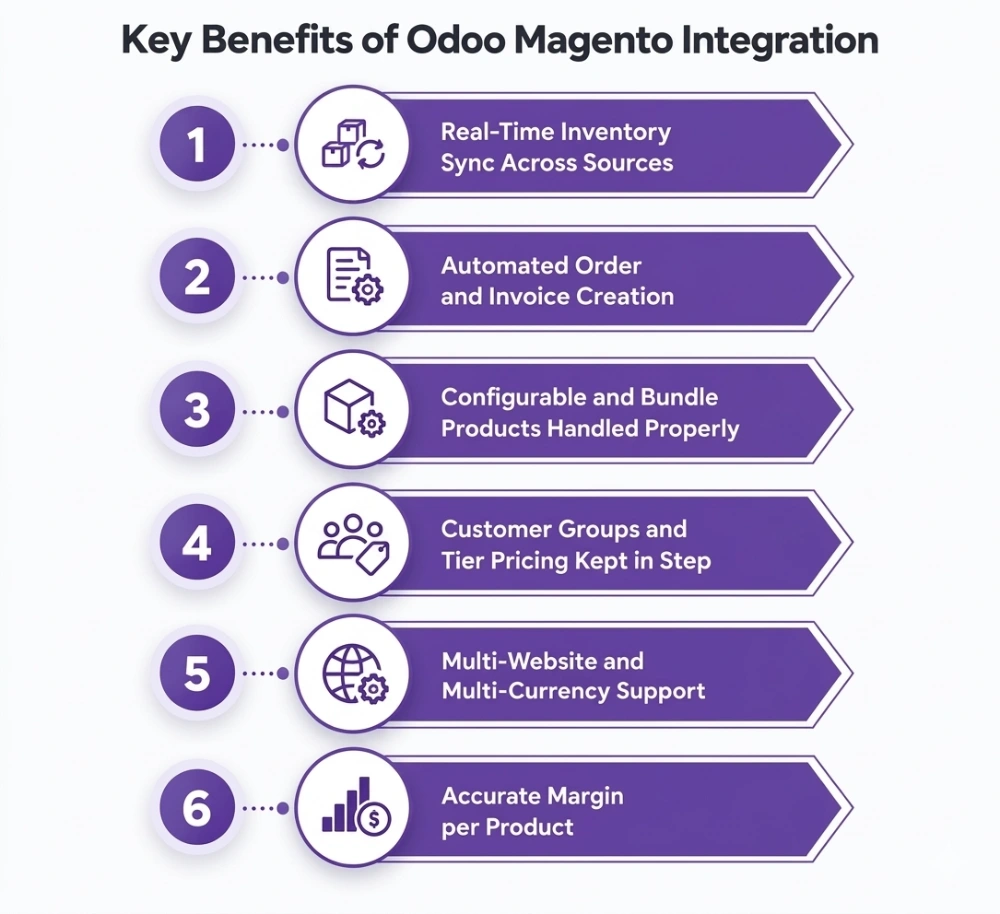
Real-Time Inventory Sync Across Sources
Odoo holds your stock and pushes quantities into the right Magento source. Multiple Odoo warehouses map to multiple MSI sources, so a customer sees availability that reflects what you can genuinely ship from the location that will ship it.
Automated Order and Invoice Creation
A Magento order lands in Odoo as a sales order with line items, product options, tax, shipping method, and payment method attached. Your rules decide whether it confirms, delivers, invoices, and registers payment without anyone touching it.
Configurable and Bundle Products Handled Properly
Configurable products map to Odoo variants, bundles to kits or to component lines, and grouped products to their own logic. Each type is decided during mapping, so a bundle sale deducts the right components and costs the right amount.
Customer Groups and Tier Pricing Kept in Step
Magento customer groups map to Odoo pricelists, so wholesale, retail, and contract customers see the price your sales team agreed. Changes are made once in Odoo and reach every website that customer buys from.
Multi-Website and Multi-Currency Support
Several Magento websites feed one Odoo instance, each with its own warehouse, pricelist, tax mapping, and company. Multi-currency orders arrive with the right rate and journal applied rather than being converted by hand at close.
Accurate Margin per Product
Landed cost, freight, and duty sit against your Magento revenue inside Odoo. Margin becomes visible per SKU and per order, which is how most merchants find out that a configurable variant they promote heavily is underwater.
What Odoo Magento Integration Automates
A quote that says it syncs products has not told you which of Magento’s six product types it syncs. Agree scope object by object, with the direction and trigger named for each one.
| Data object | Direction | Trigger |
| Simple and configurable products | Odoo to Magento | On change, matched on SKU |
| Bundle and grouped products | Odoo to Magento | On change, rules set at mapping |
| Categories and attribute sets | Both | Scheduled |
| Stock quantities | Odoo to Magento | Real-time or scheduled, per source |
| Orders | Magento to Odoo | Webhook or cron |
| Customers and customer groups | Magento to Odoo | With order, deduplicated on email |
| Shipments and tracking | Odoo to Magento | On delivery validation |
| Invoices and credit memos | Both | On confirmation or shipment |
| Tier and group pricing | Odoo to Magento | On pricelist change |
| Tax classes and shipping methods | Configured once | Applied per order |
Some requirements need rules written for your business whichever connector you license. Negotiable quotes and requisition lists in Adobe Commerce B2B, partial shipments and split invoices, gift cards, store credit, and customisable product options all sit outside standard connector behaviour. They are solvable through custom development, and if they were not raised in your quote you will meet them after go-live.
How We Integrate Magento 2 With Odoo
Your cost is settled in the first two steps, before anyone writes code. A single-website store with simple products is a different project from three websites, MSI across four sources, and B2B customer groups, so we establish which one you have before quoting.
We Audit Your Magento and Odoo Setup
Your product types, attribute sets, order volume, websites and store views, MSI sources, customer groups, tax classes, Magento edition, and Odoo version and hosting. This is the front end of every Odoo consulting engagement we run, and what turns up here decides your route and most of your budget.
We Recommend a Route
| Route | Suits | Timeline |
| Connector such as Emipro, VentorTech, or Webkul | One website, standard product types, moderate volume | 3 to 5 weeks |
| Connector plus configuration | Multiple store views, MSI, mapped tax and pricing | 6 to 10 weeks |
| Middleware such as Celigo or Make | Few objects, low volume | 3 to 6 weeks |
| Custom API build | Adobe Commerce B2B, unusual fulfilment, heavy catalogues | 10 to 20 weeks |
We Map Product Types and Inventory Sources
Configurables to variants, bundles to kits or component lines, MSI sources to Odoo warehouses, and a decision on which system owns salable quantity. This is where Magento integrations fail, because a wrong product type mapping throws no error. It just deducts the wrong stock quietly for months.
We Test Against Real Orders
A configurable order, a bundle, a partial shipment, a credit memo, a tier-priced B2B order, and a high-volume batch. We test the Magento 2 REST API against rate limits and indexer behaviour, because a sync that works on a staging catalogue can stall on a live one.
We Cut Over and Monitor
Phased go-live, error logging, reconciliation checks, and cron and indexer configuration reviewed on both sides. After that you have ongoing support, because Adobe ships Magento releases and security patches on its own schedule.
Odoo Magento Integration Services From Adatasol
A connector licence is a small line on the invoice. The expensive part is discovering in month three that bundles deduct the wrong components and your salable quantity has been wrong since launch. We settle the mapping before anyone quotes you a build.
You Get a US-Based Odoo Certified Ready Partner
We work from Willoughby, Ohio, on US business hours. The same team runs your discovery, build, testing, and support, so nothing is handed to an offshore team halfway through.
We Have Been Doing ERP for 20+ Years
Magento integration touches inventory valuation, costing, and your books. Two decades of ERP delivery is what matters when the sync has to produce numbers your accountant will sign off on.
We Tell You If a Connector Is Enough
If a licensed connector covers your product types and volume, we say so and configure it properly. Custom work gets quoted when your catalogue genuinely needs it, and every requirement is classified before you agree scope.
We Fix Syncs That Are Already Broken
If your Magento sync is live and dropping orders, duplicating SKUs, or reporting stock nobody can find, that is integration rescue rather than another build. We audit what you have before recommending you replace it.
Book a free integration assessment and we will review your catalogue, your sources, and your Odoo setup, then tell you which route fits.
Odoo Magento Integration FAQs
Does Odoo integrate with Magento 2?
Yes. Magento 2 and Adobe Commerce connect to Odoo through licensed connector modules, middleware, or a custom API integration built on the Magento REST API. Products, orders, customers, stock, shipments, and invoices all sync. Which route suits you depends on your product types, websites, and order volume.
How do I integrate Odoo with Magento?
Create a Magento integration token with the right API scopes, install the connector, map product types, attribute sets, tax classes, inventory sources, and customer groups, then test with real orders. Mapping takes the longest and decides whether the sync stays accurate.
How much does Odoo Magento integration cost?
A connector with proper configuration is the cheapest route. Multiple websites, MSI across several sources, B2B pricing, and bundle logic push it up considerably. Cost tracks how many objects you sync and how many exceptions need rules, so we scope before quoting.
How long does it take?
Three to five weeks for one website on a licensed connector with standard product types. Six to ten weeks with multi-store views and MSI mapping. Ten to twenty weeks for custom builds involving Adobe Commerce B2B or unusual fulfilment.
How does Magento MSI work with Odoo warehouses?
Each Magento inventory source maps to an Odoo warehouse or location, and you decide which system owns salable quantity. Odoo is usually the master because it sees purchase orders and production. Magento reservations and Odoo reservations both have to be accounted for or the two drift.
Does it handle configurable and bundle products?
Configurable products map to Odoo product variants. Bundles map to kits or to component lines depending on how you want stock deducted and revenue recognised. Grouped and downloadable products need their own rules. All of it is decided during mapping rather than assumed.
Can I connect multiple websites and store views to one Odoo database?
Yes. Multiple websites map into one Odoo instance with warehouses, pricelists, tax mapping, and companies assigned per website. Plan it at the start, because retrofitting multi-website logic onto a single-site sync usually means rebuilding the mapping layer.
What if we are still on Magento 1?
Magento 1 reached end of life and no longer receives security patches, so most connectors target Magento 2 only. We usually recommend planning the platform move and the Odoo integration together, alongside your wider Odoo implementation, rather than building twice.