Odoo EDI integration connects your ERP to trading partners so purchase orders arrive as sales orders, advance ship notices go out when you ship, and invoices transmit without anyone opening a portal. It runs through a VAN, an EDI platform, the direct SPS Commerce integration, or a custom AS2 and SFTP build, depending on which partners you trade with and what they mandate.
EDI is different from every other integration you will scope. Your customer decides the standard, the version, the documents, the deadlines, and often the network. You are not choosing a better way to work, you are meeting a requirement that came with the purchase order, and getting it wrong has a price list attached. We handle that as a US-based Odoo integration partner.
Why Your Trading Partners Need Odoo EDI Integration
Large retailers, distributors, and manufacturers will not take orders or pay invoices any other way. If you supply them, EDI is the cost of the account, and running it manually creates four problems.
Your Customer Sets the Rules, Not You
Each partner publishes a routing guide specifying document versions, required segments, label formats, and response windows. Walmart, Target, Amazon, and a regional distributor will each want something slightly different. Your integration has to satisfy all of them at once, from one Odoo instance.
Chargebacks Are Costing You Real Margin
An ASN sent after the truck arrives, a label without the right SSCC, a missing functional acknowledgement, or a UPC that does not match the item file all trigger deductions. They arrive as line items on a remittance months later, and for most suppliers they are larger than the cost of doing EDI properly.
Orders Are Rekeyed From a Partner Portal
Where there is no integration, someone logs into a web portal, reads the order, and types it into Odoo Sales. Quantities and part numbers get transposed, and the resulting short shipment becomes another deduction on top of the labor already spent.
Each New Partner Starts From Scratch
Winning a new account should not mean rebuilding your EDI setup. Without a structure that separates partner-specific mapping from your core Odoo logic, every onboarding is a fresh project and every certification cycle delays your first shipment.
Key Benefits of Odoo EDI Integration
Connected properly, documents move on your partner’s schedule without anyone watching a portal, and every transmission is logged against the Odoo record it came from.
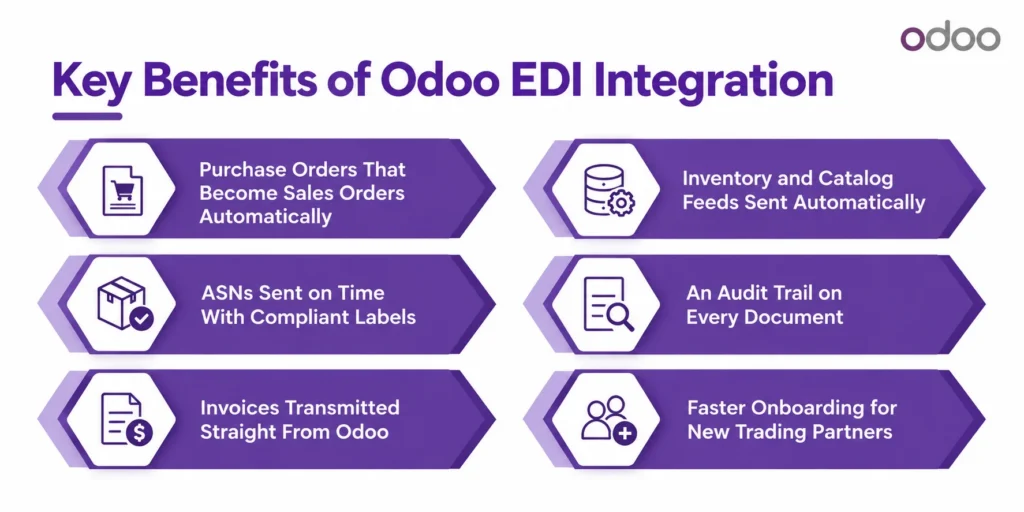
Purchase Orders That Become Sales Orders Automatically
An inbound 850 creates a sales order with the partner’s part numbers translated to your SKUs, ship-to location resolved, dates applied, and pricing checked against the agreed catalog. Exceptions are held for review rather than confirmed blindly.
ASNs Sent on Time With Compliant Labels
The 856 is generated from the actual pack structure when you ship, with SSCC-18 carton labels produced from Odoo Inventory data. Timing is what most deductions turn on, and sending from the delivery event rather than from a person is what fixes it.
Invoices Transmitted Straight From Odoo
The 810 goes out from the customer invoice with the purchase order reference, allowances, and charges your partner expects. Payment terms start running when the document is accepted rather than when someone remembers to upload it.
Inventory and Catalog Feeds Sent Automatically
846 inventory advice and 832 price catalogs go to partners and 3PLs on schedule, so buyers see current availability and your item data stays consistent with what they have on file.
An Audit Trail on Every Document
Every inbound and outbound transmission is logged against its sales order, delivery, or invoice, with acknowledgements recorded. When a partner disputes a shipment or a deduction, the evidence is one click from the record rather than in a VAN portal.
Faster Onboarding for New Trading Partners
Partner-specific mapping sits separately from your core logic, so adding an account means configuring a profile and certifying, not rebuilding. That turns EDI from a barrier into something your sales team can commit to during a negotiation.
What Odoo EDI Integration Automates
Most suppliers start with four documents and add more as partners require them. What matters is which Odoo record each one creates or comes from.
| Document | Direction | Odoo record |
| 850 Purchase order | Inbound | Creates sales order |
| 855 PO acknowledgement | Outbound | Confirms, changes, or rejects the order |
| 860 PO change request | Inbound | Amends the sales order |
| 856 Advance ship notice | Outbound | From validated delivery, with pack structure |
| 810 Invoice | Outbound | From customer invoice |
| 846 Inventory advice | Outbound | From on-hand and forecast quantities |
| 832 Price catalog | Outbound | From pricelist and product data |
| 997 Functional acknowledgement | Both | Logged against the original document |
| 940 and 945 Warehouse orders | Both | To and from a 3PL |
| 820 Remittance advice | Inbound | Matched to open invoices |
Some requirements sit outside any standard connector. GS1 SSCC-18 and UCC-128 label generation, partner-specific qualifier and segment rules, EDIFACT for European partners, drop-ship routing through a 3PL, vendor-managed inventory, and chargeback reconciliation against the deduction detail all need work built for your accounts. That is custom development, and it is usually where the return sits.
How We Integrate EDI With Odoo
Your scope is written by your trading partners, not by us. The first task is reading their routing guides and turning them into a requirement list, which is also what tells us how much of this is configuration.
We Map Your Trading Partner Requirements
Each partner’s routing guide, required documents and versions, response windows, label specifications, part number cross-references, test and certification process, and the network they trade over. This is the front end of every Odoo consulting engagement we run.
We Recommend a Route
| Route | Suits | Timeline |
| SPS Commerce direct integration | Retail suppliers already on SPS, standard document set | 4 to 8 weeks |
| VAN plus connector module | Few partners, ANSI X12, established mappings | 6 to 10 weeks |
| EDI platform with API delivery | Many partners, frequent onboarding, validation needed | 8 to 14 weeks |
| Custom AS2 or SFTP integration | Direct partner connections, unusual documents, EDIFACT | 12 to 20 weeks |
We Map Documents to Odoo Records
Partner part numbers to your SKUs, ship-to codes to delivery addresses, allowances and charges to pricelist rules, and what happens when a document arrives that does not match anything. Unmatched records must halt for review rather than create bad orders quietly.
We Certify With Each Partner
EDI testing is certification, not internal QA. Each partner runs their own cycle against sample documents before enabling production, and their timetable governs your go-live. We manage that exchange and build the retry, error, and acknowledgement handling that certification exposes.
We Cut Over and Monitor
Partners go live one at a time, with alerting on missing acknowledgements and failed transmissions. Deductions are reviewed for the first few cycles against what was actually sent. After that you have ongoing support, because routing guides get reissued and new partners arrive with new rules.
Odoo EDI Integration Services From Adatasol
An EDI project is measured by whether your largest customer keeps buying from you. That makes it different from an integration where a failure means a report is late.
You Get a US-Based Odoo Certified Ready Partner
We work from Willoughby, Ohio, on US business hours, trading ANSI X12 with the same retailers and distributors you supply. The same team runs your design, build, certification, and support.
We Have Been Doing ERP for 20+ Years
An 850 that creates the wrong sales order becomes a short shipment, a deduction, and a scorecard problem. Two decades of ERP delivery is what tells us where a document belongs and what must never post automatically.
We Build for Manufacturers and Distributors
Pallet-level pack structures, lot traceability on the ASN, and 3PL warehouse documents are normal requirements for our manufacturing and distribution clients. We scope EDI as part of how you actually ship rather than as a file transfer exercise.
We Fix EDI Setups That Are Already Failing
If documents are rejecting, acknowledgements are missing, or deductions are climbing without an obvious cause, that is integration rescue. We audit the transmission logs and the mapping before recommending any rebuild.
Book a free integration assessment and we will review your partners, their routing guides, and your Odoo setup, then tell you which route fits.
Odoo EDI Integration FAQs
Does Odoo support EDI?
Odoo does not translate EDI natively. It connects to a VAN, an EDI platform, or a direct partner link that handles translation, and the integration maps those documents to Odoo sales orders, deliveries, and invoices. Odoo announced a direct SPS Commerce integration covering the common retail document set.
Which EDI documents can Odoo handle?
Commonly 850 purchase orders, 855 acknowledgements, 856 advance ship notices, 810 invoices, 846 inventory advice, 860 change requests, 832 catalogs, and 997 acknowledgements. Warehouse documents such as 940 and 945 apply where a 3PL ships for you. Additional document types are built as partners require them.
Do I need a VAN?
Not always. VANs remain common in retail supply chains, but modern EDI platforms deliver over API instead, and some partners accept direct AS2 or SFTP connections. Your partners often specify the network, so the decision is frequently made for you before you scope anything.
What causes EDI chargebacks?
Late or missing advance ship notices, non-compliant carton labels, incorrect UPC or GTIN data, missing acknowledgements, wrong quantities against the purchase order, and shipping outside the delivery window. Most are timing or data problems that an integration removes, which is usually the clearest return on the project.
Can Odoo produce GS1 SSCC-18 and UCC-128 labels?
Not as standard. Compliant carton and pallet labels are generated from Odoo pack data through a label solution built or configured for your partners’ specifications, since format requirements vary by account and are a frequent source of deductions.
How much does Odoo EDI integration cost?
The build is one part and the network or platform subscription is another, usually charged per document or per partner. Cost tracks the number of trading partners, documents each requires, and how much label and pack complexity is involved, so we scope against your routing guides before quoting.
How long does it take?
Four to eight weeks for a standard retail document set on an existing platform. Six to fourteen weeks across several partners with mapping and validation. Certification timetables belong to your partners, so their availability often determines go-live more than development does.
Which Odoo versions and hosting are supported?
EDI modules cover Odoo 16 through 19, and custom or partner-specific mapping needs Odoo.sh or self-hosted rather than Odoo Online. Because EDI touches sales, inventory, and invoicing together, it is worth settling alongside your wider Odoo implementation.