
Odoo can be worth the investment in 2026 when it removes operational friction and replaces disconnected tools with one reliable system. The real question is not whether Odoo is a good ERP. It is whether your rollout will deliver measurable outcomes like faster processing, fewer errors, cleaner data, and better visibility across teams.
If your organization relies on spreadsheets, duplicate data entry, manual handoffs, delayed reporting, and inconsistent process ownership, Odoo often delivers strong value because it centralizes workflows across sales, purchasing, inventory, accounting, manufacturing, projects, and service. If your business is already standardized, your current ERP is stable, and the main constraint is adoption rather than system capability, the return can be weaker unless the scope stays focused and governance stays disciplined.
TL;DR
- Odoo is worth the investment when it replaces manual work and disconnected tools with reliable end-to-end workflows, clean data, and consistent controls.
- The biggest ROI drivers are process standardization, inventory accuracy, faster order-to-cash, faster procure-to-pay, and a reliable financial close.
- The biggest ROI killers are unclear scope, messy data, over-customization, weak user adoption, and unmanaged integrations.
- Best results come from a phased rollout with measurable success metrics, clear acceptance criteria, and strong ownership after go-live.
What Investment Means for Odoo ERP
When you evaluate an ERP, it is easy to focus on license cost. The real investment includes both money and organizational effort.
1) Direct costs
- Licenses and hosting
- Implementation services (discovery, configuration, training, go-live)
- Integrations (APIs, connectors, reconciliation)
- Data migration (cleansing, mapping, validation)
- Custom development (only when necessary)
- Testing and training
2) Indirect costs
- Time from process owners and key users
- Temporary productivity dip during the transition
- Workflow adoption and team readiness
- Ongoing ownership (data owners, access reviews, process discipline)
3) Opportunity cost
- The cost of staying as you are: errors, delays, manual reporting, inventory write-offs, missed sales, slow fulfillment, poor visibility
- The cost of patching multiple tools and spreadsheets instead of building one coherent system
If you are paying for several disconnected systems plus human workarounds, your baseline cost is probably higher than it looks.
When Odoo ERP Is Worth It
Odoo tends to be worth the investment when it removes operational bottlenecks you can measure.
1) You have cross-department friction
Common signals:
- Sales commits dates that operations cannot reliably meet
- Purchasing is reactive and vendor lead times are not followed
- Inventory accuracy is weak, leading to backorders or overstock
- Accounting spends days on manual reconciliation each month
- Customer service cannot quickly see accurate order status
ERP value is highest when the same data serves multiple teams without re-entry.
2) You rely heavily on spreadsheets for core operations
Spreadsheets are useful, but once they become your system of record, you lose:
- Auditability
- A single source of truth
- Consistent validation rules
- Permission control and approvals
- Reliable reporting
Odoo becomes valuable when it replaces spreadsheet-driven operations with controlled workflows.
3) Inventory and fulfillment are business-critical
If you carry inventory, every percentage point of accuracy matters:
- Stockouts reduce revenue
- Overstock ties up cash
- Mis-picks hurt customer experience
- Inaccurate valuation disrupts finance
A solid ERP rollout pays back quickly when it improves stock reliability and fulfillment speed.
4) You need operational and financial visibility in one place
A key ERP benefit is that transactions and accounting stay connected. When sales, purchasing, and inventory correctly feed finance, you get:
- Faster month-end close
- Fewer manual adjustments
- Better margin visibility
- More reliable cash flow forecasting
5) Your business is growing faster than your systems
Growth adds complexity:
- More SKUs
- More customers and vendors
- More approvals
- More warehouses or locations
- More people who need consistent processes
At a certain point, adding another tool or spreadsheet stops solving the coordination problem.
Looking for Odoo Implementation, Customization, Integration, or Support Services?
When Odoo ERP May Not Be Worth It
Sometimes the right answer is not yet or not this year.
1) Your processes are not stable enough to systemize
If workflows change weekly, ERP scope becomes a moving target. You can still implement, but keep phase 1 tight and avoid locking unstable processes into software.
2) Leadership will not enforce process ownership
ERP needs clear ownership for pricing rules, product creation, approvals, and reporting definitions. Without it, the system drifts, data becomes inconsistent, and user trust drops.
3) Your team expects the ERP to fix broken processes by itself
ERP reveals process issues. It does not solve them without decisions. If you are not ready to standardize, the return will be lower.
4) You plan heavy customization to preserve every legacy habit
Customization can be justified, but too much increases:
- Implementation time
- Testing effort
- Maintenance burden
- Upgrade complexity
If the plan is to rebuild the old system inside the new ERP, the investment is harder to justify.
5) You have simple needs and a stable, lightweight stack
If you only need basic invoicing, simple sales tracking, and simple reporting, a full ERP may not deliver enough incremental value relative to the effort.
How Odoo Produces ROI for Your Business
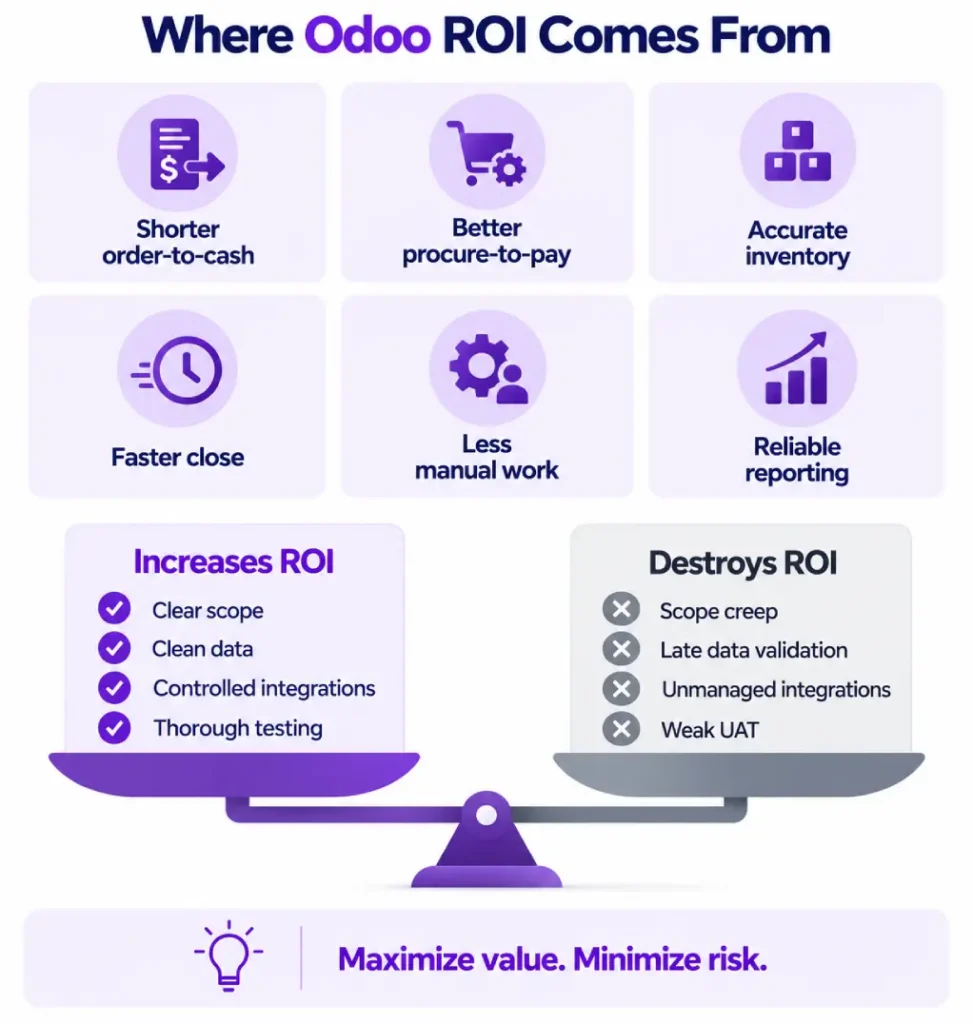
ERP return comes from fewer mistakes, faster execution, and better decisions. These are the most common value levers.
1) Shorter order-to-cash cycle
What improves
- Faster quoting and order confirmation
- Fewer errors in fulfillment and invoicing
- Better payment follow-up workflows
Value outcome
- Improved cash flow
- Fewer billing disputes
- Higher customer satisfaction
2) Improved procure-to-pay control
What improves
- Structured purchasing approvals
- Clearer visibility into vendor performance
- Better matching between receipt, bill, and payment
Value outcome
- Fewer overpayments and duplicates
- Better vendor terms
- Reduced procurement delays
3) Inventory accuracy and working capital improvements
What improves
- Correct stock levels by location
- Clearer replenishment logic
- Fewer emergency purchases and expedited shipping costs
Value outcome
- Lower stockouts and less overstock
- Higher fill rate
- Better cash utilization
4) Faster close and cleaner accounting
What improves
- Fewer manual journal entries
- Less reconciliation work
- More consistent transaction coding
Value outcome
- Faster month-end close
- Better audit readiness
- Clearer profitability reporting
5) Reduced manual work and duplicated data entry
What improves
- Fewer handoffs between tools
- Fewer repeated entries across CRM, accounting, and inventory
- Fewer spreadsheet merges
Value outcome
- Labor savings
- Fewer errors
- Faster response time
6) Better decision-making through reliable reporting
What improves
- Consistent definitions of KPIs
- Fewer competing versions of the truth
- Near real-time operational visibility
Value outcome
- Better forecasting
- Better prioritization
- Earlier detection of issues
The Hidden Factor: Implementation Quality
The same software can be a great investment or a disappointment, depending on how disciplined the implementation is.
What increases the chance of a strong ROI
- Clear scope boundaries with phased delivery
- Explicit acceptance criteria and sign-offs
- Clean master data ownership
- Controlled integrations with monitoring and reconciliation
- Real end-to-end testing, including exception paths
- Role-based training and adoption support
- Strong post-go-live support and steady-state ownership
What destroys ROI
- Scope creep without change control
- Data migration done late or without validation
- Integrations built without failure handling
- Custom development used to compensate for unclear requirements
- Weak UAT and rushed training
- No ownership for master data and approvals
ERP success is not only a technical program. It is an ownership and discipline program.
Is Odoo Really Worth It for Your Business?
Use these questions to make a clear investment decision.
1) What operational pain costs you the most today?
Pick the top three:
- Late shipments
- Inaccurate inventory
- Slow invoicing and collections
- Manual month-end close
- Poor visibility into margins
- Rework and errors from duplicate data entry
- Missed sales due to slow quoting or weak follow-up
If you cannot name the cost, ROI will be hard to prove.
2) Which workflows must improve in phase 1?
Phase 1 should focus on workflows that:
- Move money
- Move inventory
- Reduce compliance risk
- Reduce customer-impacting delays
Everything else can come after stability.
3) What data must be correct on day one?
Most teams need:
- Products, customers, vendors
- Opening balances
- Open orders and open invoices
- Inventory quantities by location
Importing all history is rarely necessary for phase 1 and often delays timelines.
4) How many integrations are truly required at go-live?
Every integration adds:
- Build time
- Failure points
- Monitoring needs
- Reconciliation work
Integrate what is required to operate. Defer nice-to-have connections until after stabilization.
5) Are you prepared to enforce ownership and discipline?
ERP needs:
- Master data owners
- Approval rules
- Access control discipline
- Change control for enhancements
If this is not realistic, the system drifts and user trust drops.
Scenarios Where Odoo Is Commonly a Strong Investment
| Scenario | Best fit example | High value comes from |
| Scenario A | Distribution business with inventory and shipping | Accurate stock visibility Faster picking and shipping Fewer mis picks and returns Better purchasing control |
| Scenario B | Service and project-based company | Consistent quoting and project execution Better resource visibility Clearer invoicing and revenue tracking |
| Scenario C | Manufacturing with traceability and quality needs | BOM and routing discipline Production visibility Quality checks and traceability Inventory valuation accuracy |
| Scenario D | Multi-entity group that needs operational consistency | Standardized processes across entities Consistent reporting definitions Controlled inter-company workflows when needed |
Is Another ERP Better Than Odoo?
Sometimes, yes, but only if it is a better fit for how you operate. Odoo usually wins when you want a broad suite, a modular rollout, and flexibility without enterprise-level overhead.
If you are weighing Odoo against SAP, NetSuite, or Dynamics 365, the comparison depends less on feature checklists and more on implementation effort, total cost of ownership, and time-to-value for your workflows. Our breakdown of ” How does Odoo compare to other ERP systems ” covers the differences in more detail.
Conclusion
Odoo ERP is worth the investment when it replaces operational friction with governed workflows and trustworthy data. The return is strongest when inventory accuracy improves, cash cycles shorten, close cycles speed up, and teams stop maintaining multiple versions of truth. The investment is hardest to justify when scope is uncontrolled, data is unmanaged, customization is excessive, and adoption is weak.
The practical answer is this: if you can commit to clear scope, ownership, data discipline, and user adoption, Odoo can be a high-leverage operational investment in 2026.

