Adatasol configures Odoo for automotive manufacturers, specialty vehicle builders, EV manufacturers, commercial vehicle producers, vehicle assembly operations, trailer manufacturers, upfitters, and automotive production teams that need ERP control around programs, platforms, variants, BOMs, work orders, suppliers, quality records, inventory, costing, shipments, and connected systems. Standard Odoo does not cover every automotive manufacturing requirement out of the box. Each requirement is mapped as standard, configured, or extended before scope is agreed.
Where Generic ERP Configurations Fall Short in Automotive Manufacturing Operations
Automotive manufacturing is program-driven, supplier-driven, and traceability-driven. A finished vehicle, major assembly, or configured build is defined by more than a product number. It may begin with a customer forecast or order, vehicle program, platform, model, variant, engineering drawing, specification, revision, BOM, work order, supplier component, material lot, serialized part, station check, inspection record, delivery order, ASN, shipment, warranty claim, recall investigation, rework, credit, or corrective action record.
Vehicle Programs Change the Production Record
Automotive manufacturers manage programs, platforms, models, trims, option packages, markets, launch stages, and customer-specific requirements. If program and variant data are disconnected from BOMs, work orders, suppliers, quality records, and shipments, teams lose visibility into what is approved, planned, built, inspected, and delivered.
BOMs and Revisions Affect Every Build
Automotive production depends on multi-level BOMs, assemblies, subassemblies, supplier components, engineering drawings, revision status, effective dates, and controlled changes. A generic ERP setup may track product structure but still miss the approval, revision, and production-impact records that automotive teams need during launch and ongoing production.
Supplier Components Need Traceability
Supplier components, material lots, serialized parts, approved suppliers, purchase orders, receipts, inbound inspections, quality holds, and supplier corrective actions affect production flow and warranty risk. If supplier data is separated from manufacturing and shipment records, traceability investigations take longer and quality issues become harder to contain.
JIT, JIS, and Release Schedules Add Planning Pressure
Automotive manufacturers may need to work around customer forecasts, release schedules, kanban replenishment, just-in-time demand, just-in-sequence delivery, supplier lead times, capacity constraints, and shipment windows. Odoo provides a planning foundation, but customer-specific release logic, sequencing, cumulative shipment tracking, and EDI-driven scheduling usually require configuration or integration.
Quality Records Must Stay Connected
Automotive quality workflows may include receiving inspection, in-process inspection, final inspection, control plans, defect codes, nonconformance records, holds, releases, rework, scrap, corrective actions, warranty claims, and customer-specific documentation. Those records need to stay connected to the program, BOM, supplier, lot, serial, work order, shipment, and customer.
EDI, Labels, and Shipments Often Require Integration
Automotive customers may require EDI transactions, ASNs, barcode labels, packing rules, shipping documents, delivery confirmations, invoices, and customer-specific data formats. Odoo can hold the ERP-side records, while EDI, labeling, WMS, TMS, customer portals, and supplier systems may remain connected platforms.
How Automotive Manufacturing Requirements Map to Odoo
Automotive manufacturing runs on the same Odoo core of BOMs, work orders, variants, inventory, purchasing, sales, quality records, and accounting as other manufacturing operations, built around the Odoo Manufacturing module. What separates automotive manufacturing is the way programs, platforms, vehicle variants, suppliers, engineering revisions, release schedules, quality records, traceability, EDI, shipments, warranty claims, and corrective actions have to connect.
| Automotive Manufacturing Requirement | Odoo Capability | Classification |
| BOMs for vehicles, assemblies, subassemblies, components, kits, and packaging | Bills of materials with components and operations | Standard |
| Assembly, inspection, packing, and release-preparation steps | Operations defined on the BOM and assigned to work centers | Standard |
| Work order tracking by station, line, process, or work center | Manufacturing work orders with operation and work-center status | Standard |
| Lot and serial traceability | Lot and serial tracking across receipt, production, storage, and delivery | Standard |
| Planned versus actual manufacturing-order cost | Cost comparison on the manufacturing order | Standard |
| Make-to-order automotive production | Replenish on Order with the Manufacture route | Standard |
| Unit conversion within one compatible category | Unit of measure conversion for compatible units | Standard |
| Product variants for model, trim, market, option package, or configuration | Product attributes and variants with configured attribute values | Standard to Configured |
| Variant-specific BOM components | BOM components assigned through variant logic where applicable | Standard to Configured |
| Drawing, specification, approval, and revision references | Product fields, attachments, approval workflows, and Odoo PLM | Configured |
| Engineering change orders and BOM version control | Odoo PLM engineering change and version-control workflows | Configured |
| Program, platform, launch, milestone, and APQP-style record tracking | Configured project, quality, product, task, and document workflows | Configured to Extended |
| Control Plan, FMEA, MSA, SPC, PPAP, and customer-specific record packages | Configured quality, document, approval, and reporting workflows | Configured to Extended |
| Supplier releases, forecast schedules, and customer release planning | Configured sales, purchase, MRP, or integration workflows | Configured to Extended |
| JIT, JIS, kanban, and sequence-driven replenishment | Configured routes, replenishment, barcode, scheduling, or external integration | Configured to Extended |
| Automotive EDI, ASN, labels, and customer-specific shipping documents | API, file-based, connector, middleware, or custom integration | Configured to Extended |
| Supplier scorecards and supplier quality workflows | Configured purchase, quality, receipt, inspection, and reporting records | Configured to Extended |
| Warranty, recall, and claim traceability | Configured serial, lot, repair, helpdesk, quality, and reporting workflows | Configured to Extended |
| MES, PLC, machine, line, barcode, QMS, PLM, CAD, WMS, labeling, and shipping integrations | API, file-based, connector, middleware, IoT, or custom integration | Configured to Extended, interface-dependent |
| Real-time line balancing, automated sequence optimization, machine control, vision inspection, and advanced finite-capacity scheduling | External system or custom integration | Extended |
Odoo Capabilities We Configure for Automotive Manufacturers
Program, Platform, and Variant Control
Odoo can maintain vehicle programs, platforms, models, trims, option packages, customer-specific requirements, product attributes, variants, SKUs, attachments, approvals, and revision references. These records can be associated with quotations, sales orders, BOMs, purchase orders, manufacturing orders, quality checks, inventory, deliveries, invoices, warranty claims, and corrective actions.
BOM, Routing, and Work Order Control
Odoo BOMs can structure vehicles, assemblies, subassemblies, kits, supplier components, packaging, and finished outputs. Operations can represent body assembly, chassis assembly, trim, paint-related preparation, electrical installation, battery-pack assembly references, final assembly, inspection, packing, and dispatch preparation where those steps belong in the ERP production model.
Supplier and Material Traceability
Odoo lot and serial tracking can link supplier, purchase order, receipt, supplier component, material lot, serialized part, inspection record, manufacturing order, consumed material, produced assembly, finished output, delivery order, shipment, claim, and corrective action. Genealogy comes from the lots and serials consumed and produced on manufacturing-order transactions.
Engineering Change and Revision Control
Odoo can maintain product records, BOM versions, document attachments, approval steps, revision references, and engineering change workflows. Drawing-number fields, approval rules, effective-date logic, and controlled revision workflows are configured through implementation design and Odoo PLM where needed.
Automotive Quality Records
Quality control points can capture receiving inspection, in-process inspection, final inspection, measurement results, defect codes, defect severity, nonconformance, holds, releases, rework reasons, scrap, supplier issues, corrective actions, photos, and attachments. Advanced APQP, PPAP, Control Plan, FMEA, MSA, SPC, audit, and customer-specific quality-package workflows may require configuration, reporting, or integration with a specialist QMS.
JIT, JIS, Kanban, and Release Planning
Odoo can support replenishment rules, make-to-order production, manufacturing orders, purchase orders, inventory moves, lead times, routes, and demand-driven planning. Automotive-specific release schedules, just-in-time supply, just-in-sequence delivery, kanban loops, cumulative shipment tracking, and customer-driven schedule changes may require configured workflows or EDI integration.
EDI, ASN, Labeling, and Shipping
Odoo can connect sales orders, delivery orders, packages, invoices, customer records, supplier records, and shipment documents. Automotive EDI transactions, ASNs, customer-specific labels, packing rules, carrier requirements, portal updates, and shipment confirmations normally require connector, middleware, API, file-based, or custom integration after trading-partner requirements are assessed.
Costing, Variance, and Margin Visibility
Odoo tracks planned versus actual manufacturing-order cost, material consumption, work-center cost, scrap, by-products where relevant, and finished output. Automotive-specific reporting can extend this view to launch cost, supplier cost, rework cost, warranty cost, expedite cost, outside-processing cost, freight, credits, and margin through configured reports or custom development when standard records are not enough.
Warranty, Recall, and Claim Records
Warranty, recall, and claim workflows can connect finished vehicle or assembly records, serial numbers, supplier components, lots, work orders, inspection results, delivery records, customer claims, rework, credits, and corrective actions. Odoo can support the record layer for investigations, while legal, customer, regulatory, and procedural decisions remain the manufacturer’s responsibility.
Automotive Manufacturing Operations Odoo Can Support
Odoo fits the ERP layer for automotive manufacturers that need quoting, purchasing, inventory, production, quality records, costing, shipping, and financial reporting in one system. It is not a replacement for every MES, PLM, CAD, QMS, EDI, sequencing, WMS, barcode-labeling, supplier-portal, or machine-control system by default.
Specialty Vehicle Manufacturers
Operations producing specialty vehicles where programs, models, options, assemblies, suppliers, quality records, serial numbers, costing, delivery documents, and customer-specific requirements need ERP visibility.
EV Manufacturers
Electric vehicle manufacturers managing battery-pack references, electronics, serialized components, supplier lots, high-value assemblies, inspection records, inventory, production orders, shipments, and warranty traceability.
Commercial Vehicle Manufacturers
Companies producing trucks, buses, trailers, bodies, chassis, mobility vehicles, or commercial platforms where models, options, subassemblies, work orders, suppliers, and inspections need to stay connected.
Vehicle Assembly Operations
Assembly operations managing stations, work orders, subassemblies, supplier components, material issue, in-process inspection, final inspection, finished output, packing, shipment, and cost records.
Trailer Manufacturers
Trailer manufacturers managing frames, axles, electrical components, decking, panels, options, serial numbers, assemblies, work orders, inspections, finished-goods inventory, and delivery records.
Upfitters and Vehicle Modification Operations
Upfitters managing customer-specific vehicle builds, kits, installed equipment, options, work orders, approvals, quality checks, delivery documents, service records, and claim history.
Program-Driven Automotive Manufacturers
Program-driven operations managing launch milestones, engineering changes, supplier readiness, quality documentation, release schedules, cost control, shipment documents, and ongoing production records.
Records and Workflows That Support Automotive Quality Requirements
Certification, customer approval, audit readiness, validation, cybersecurity, hosting, and procedural controls remain the manufacturer’s responsibility. Odoo does not guarantee IATF 16949 certification, PPAP approval, APQP completion, MMOG/LE performance, customer acceptance, or regulatory compliance. What it can be configured to do is maintain the records that make programs, suppliers, materials, work orders, quality checks, shipments, warranty claims, recalls, and corrective actions retrievable.
| Requirement Area | What the Business Typically Needs | Records Odoo Can Maintain |
| Program and launch control | Vehicle program, platform, model, launch milestone, engineering status, supplier readiness, and customer requirement | Product records, project records, tasks, approvals, attachments, configured fields, and status records |
| Engineering control | Drawing, specification, revision, ECO, approved BOM, effective date, and approval status | Product records, BOM versions, ECO records, attachments, approvals, and revision references |
| Supplier quality | Approved supplier, receipt, inspection, defect, supplier corrective action, and supplier performance | Vendor records, purchase orders, receipt records, quality checks, quality alerts, corrective actions, and configured reports |
| Production traceability | Supplier component, material lot, serialized part, work order, assembly record, consumed material, and finished output | Lot records, serial numbers, inventory moves, manufacturing-order consumption records, and produced output records |
| Automotive quality tools | APQP, Control Plan, FMEA, MSA, SPC, PPAP reference, customer-specific document, and approval package | Configured quality records, document references, approvals, attachments, checklists, tasks, and dashboards |
| Nonconformance and rework | Defect code, severity, hold, disposition, rework, scrap, use-as-is decision, supplier return, and release | Quality checks, quality alerts, manufacturing records, scrap records, inventory status, attachments, and corrective actions |
| Shipment control | Delivery order, packing list, ASN, barcode label, customer document, invoice, and proof of shipment | Delivery records, package records, customer records, invoices, attachments, and integration records |
| Warranty and recall support | Vehicle, serial number, supplier component, lot, shipment, customer claim, defect, and corrective action | Serial records, lot records, delivery records, repair or claim records, quality records, and configured traceability reports |
| Cost and margin control | Material cost, supplier cost, labor cost, work-center cost, rework, scrap, warranty, freight, credit, and claim cost | Manufacturing-order cost, purchase cost, inventory valuation, scrap records, credit records, claim records, and configured margin reports |
Odoo Modules We Implement for Automotive Manufacturing Companies
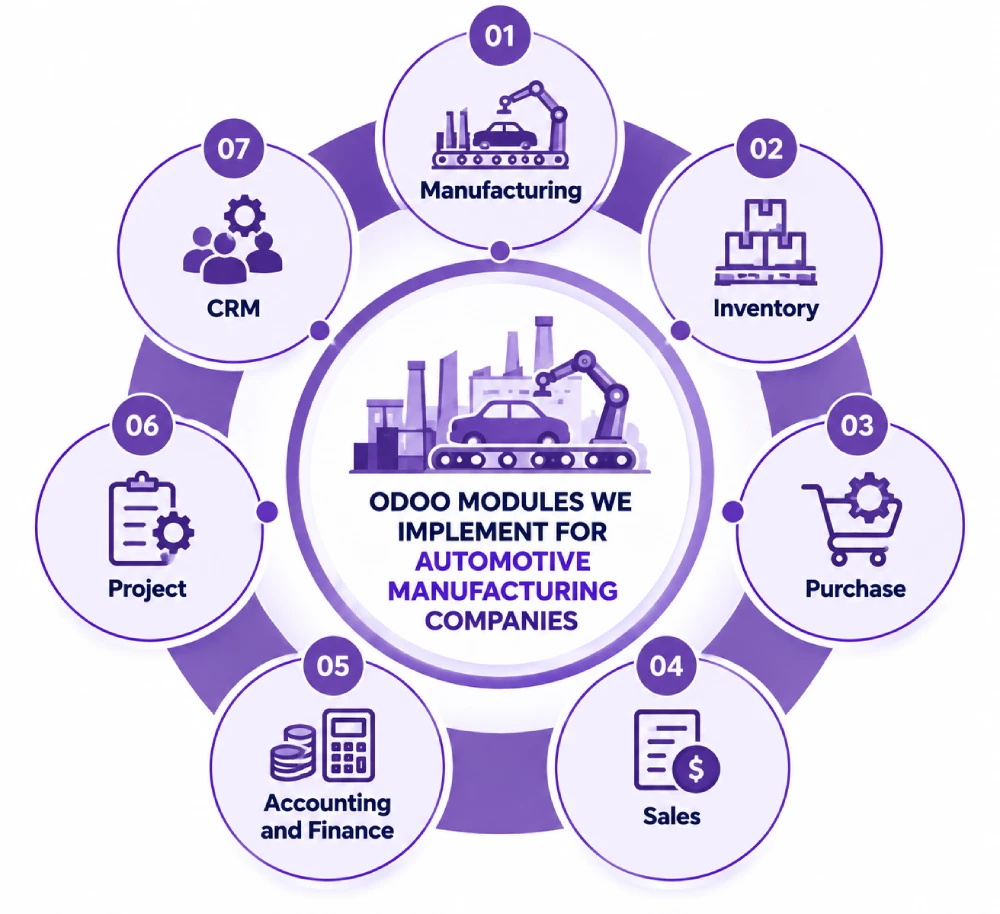
Manufacturing
Runs BOMs, work orders, work centers, manufacturing-order cost, scrap, by-products where relevant, and production operations for assemblies, subassemblies, stations, inspections, packing, and release preparation.
Inventory
Tracks supplier components, material lots, serialized parts, subassemblies, finished vehicles, packages, pallets, containers, warehouses, locations, transfers, receipts, issues, returns, and shipments.
Purchase
Manages suppliers, RFQs, purchase orders, vendor pricing, approved supplier records, supplier documents, receipt records, subcontracting foundations, and landed-cost allocation where required.
Sales
Connects quotations, customer orders, vehicle configurations, make-to-order production, customer-specific pricing, delivery commitments, shipment records, invoices, credits, returns, and claim references.
Accounting and Finance
Connects inventory valuation, landed costs, manufacturing-order cost, supplier bills, customer invoices, credits, freight, warranty claims, rework, scrap, outside-processing cost, and margin reporting.
Project
Supports program launches, engineering tasks, customer approvals, supplier readiness, APQP-style task tracking, milestone tracking, issue follow-up, and project-linked production requirements where needed.
CRM
Supports opportunity tracking, account visibility, customer communication, program opportunities, quote handoff, and sales follow-up before the order enters production.
Adatasol selects and connects the Odoo applications required for automotive quoting, purchasing, production, inventory, quality, shipping, finance, costing, and reporting workflows through Odoo consulting.
Systems We Connect Odoo With
Automotive manufacturers often run engineering, production-floor, supplier, customer, warehouse, and logistics systems that Odoo should connect with rather than replace. Odoo integration defines the data flow, synchronization rules, ownership model, and interface method for each connected system.
- MES and production-floor systems for station status, line activity, downtime, WIP, production output, rework, and shift reporting
- PLM and engineering systems for product data, drawings, revisions, ECOs, specifications, and approved engineering records
- CAD and document systems for drawings, models, attachments, work instructions, and controlled production references
- QMS platforms for APQP, PPAP, Control Plan, FMEA, MSA, SPC, audit records, CAPA, and customer-specific quality workflows
- EDI and customer portals for forecasts, releases, purchase orders, acknowledgments, ASNs, invoices, shipment confirmations, and customer-specific documents
- Barcode, WMS, and labeling systems for receiving, putaway, material issue, WIP movement, finished-goods picking, packing, customer labels, and shipment capture
- Supplier portals and procurement systems for supplier schedules, confirmations, documents, quality issues, corrective actions, and supplier performance records
- Shipping, TMS, freight, and customer delivery systems for packing lists, carrier data, tracking, delivery appointments, proof of shipment, and freight records
- Legacy ERP, QuickBooks, spreadsheets, or Access databases where customer, product, BOM, supplier, inventory, quality, shipment, or financial data still lives
Some compatible devices can connect through Odoo IoT. CAD, CAM, cutting machines, scales, MES platforms, and controllers may be integrated after the available interface and device compatibility are assessed. Where a legacy platform holds critical operational data, Odoo data migration and legacy system modernization can migrate approved historical and operational data into Odoo as part of the rollout.
Comparing Odoo With Other Automotive ERP Options
Automotive manufacturers may compare Odoo with automotive ERP systems, MES platforms, QMS platforms, PLM systems, EDI platforms, WMS tools, supplier portals, and customer-specific production systems. The right choice depends on how each option handles programs, variants, BOMs, releases, suppliers, quality records, traceability, EDI, labeling, shipments, warranty claims, integrations, and total cost over the license horizon. Adatasol maps those requirements openly so the business can see where Odoo fits and where configuration, development, or a connected specialist system may be required. If another platform is a better fit for the operation, we will say so. Where a previous Odoo implementation has stalled, Odoo implementation rescue is available to recover it.
What We Assess Before an Odoo Implementation in Automotive Manufacturing
Before an Odoo implementation scope is agreed, Adatasol assesses how the operation runs and which requirements are standard, configured, or extended.
Automotive Production Model
Whether the business produces specialty vehicles, EVs, commercial vehicles, trailers, upfitted vehicles, major assemblies, configured builds, make-to-order production, project-linked production, or repeat finished goods.
Program, Platform, and Variant Structure
Programs, platforms, models, trims, option packages, markets, customer-specific requirements, revisions, engineering documents, effective dates, and approvals affect how Odoo should structure products, BOMs, orders, and production records.
Supplier, BOM, and Traceability Depth
Supplier components, material lots, serial numbers, purchase orders, receipts, inspections, subassemblies, finished outputs, shipments, claims, and recalls need to remain traceable through manufacturing consumption and production transactions.
Quality and Automotive Record Requirements
Receiving inspection, in-process inspection, final inspection, APQP references, PPAP references, Control Plan references, defect codes, nonconformance, rework, holds, releases, supplier corrective actions, and warranty records affect how Odoo should model quality workflows.
Release, EDI, and Shipment Requirements
Customer forecasts, releases, JIT schedules, JIS requirements, kanban loops, ASNs, barcode labels, packing rules, customer portals, delivery documents, invoices, and shipping confirmations affect integration and reporting scope.
Costing and Margin Requirements
Material cost, supplier cost, labor cost, work-center cost, outside-processing cost, scrap, rework, expedite cost, warranty claims, credits, freight, and margin must be assessed together because they affect production cost, inventory valuation, shipment records, and financial reporting.
Data Migration Scope
Customer, supplier, product, program, BOM, routing, revision, drawing, inventory, lot, serial, quality, shipment, claim, warranty, and financial records may need to move into Odoo.
Integration Requirements
MES, PLM, CAD, QMS, EDI, WMS, barcode, labeling, supplier portal, customer portal, shipping, accounting, reporting, and legacy systems need interface assessment before integration scope is agreed.
Why Work With Adatasol on an Automotive ERP Project
Certified Odoo Ready Partner
Adatasol is a U.S.-based Odoo Certified Ready Partner that assesses, configures, and extends Odoo for automotive manufacturing requirements.
More Than 20 Years of ERP Delivery in Manufacturing
Adatasol has more than 20 years of ERP and enterprise software experience across manufacturing and industrial organizations.
Classification Before Commitment
Each automotive manufacturing requirement is mapped as standard, configured, or extended so the main scope and cost drivers around programs, variants, BOMs, suppliers, quality records, traceability, EDI, shipments, costing, and integrations are identified before commitment.
One U.S.-Based Team
Assessment, configuration, development, migration, integration, training, and support come from one U.S.-based team rather than a handoff chain.
Phased Delivery
We plan the rollout in phases so operations move to Odoo in a sequence that reduces disruption to shipping and daily production.
Ongoing Support After Go-Live
Odoo support continues after go-live as the manufacturer adds programs, products, suppliers, work centers, warehouses, reports, quality records, integrations, users, and operating locations.
Odoo for Automotive Manufacturing FAQs
Can Odoo be used for automotive manufacturing?
Yes. Odoo handles the automotive manufacturing ERP core of BOMs, work orders, inventory, lot and serial traceability, scrap, by-products where relevant, manufacturing-order cost, purchasing, sales, and accounting. Automotive-specific requirements such as EDI, JIT, JIS, APQP, PPAP, sequencing, customer labels, supplier scorecards, and MES integration are handled through implementation design.
Is Odoo suitable for vehicle manufacturers and specialty vehicle builders?
Yes, when the requirements are mapped correctly. Odoo can support vehicle manufacturers, specialty vehicle builders, EV manufacturers, commercial vehicle producers, trailer manufacturers, upfitters, and assembly operations through configured products, BOMs, work orders, suppliers, inventory, quality records, costing, shipments, and financial workflows.
Can Odoo manage automotive BOMs and work orders?
Yes. Odoo supports BOMs, operations, work centers, manufacturing orders, work orders, and shop-floor execution. Automotive BOMs can be configured around programs, platforms, models, variants, assemblies, subassemblies, supplier components, packaging, quality checkpoints, and customer-specific requirements.
Can Odoo manage automotive product variants?
Product variants provide a foundation for models, trims, option packages, markets, configurations, and customer-specific requirements. Complex vehicle configurators, sequence-specific build logic, advanced pricing rules, and order-specific BOM automation usually require configuration, integration, or custom development.
Can Odoo track automotive lots and serial numbers?
Yes. Odoo can track supplier components, material lots, serialized parts, subassemblies, finished outputs, packages, shipments, returns, and claims through inventory, manufacturing, delivery, and quality records. Genealogy comes from the lots and serials consumed and produced on manufacturing-order transactions.
Can Odoo support IATF 16949 requirements?
Odoo can maintain quality, production, traceability, supplier, shipment, and corrective-action records that support automotive quality management workflows. Certification, customer approval, audit readiness, validation, cybersecurity, hosting, and procedural controls remain the manufacturer’s responsibility.
Can Odoo manage PPAP, APQP, Control Plan, FMEA, MSA, and SPC records?
Odoo can be configured to store references, documents, approvals, tasks, quality checks, inspection results, attachments, and reporting around PPAP, APQP, Control Plan, FMEA, MSA, and SPC workflows. Advanced quality-package automation or statistical workflows may require configuration, custom reporting, or integration with a specialist QMS.
Can Odoo support JIT, JIS, kanban, and release schedules?
Odoo can support replenishment rules, purchasing, manufacturing, inventory moves, lead times, routes, and demand-driven planning. Customer-specific release schedules, just-in-time replenishment, just-in-sequence delivery, cumulative shipment tracking, and schedule-change logic usually require configured workflows or EDI integration.
Can Odoo integrate with automotive EDI?
Yes, where the trading-partner requirements and technical interfaces support it. Automotive EDI may connect through connector, middleware, API, file-based exchange, or custom integration for forecasts, releases, purchase orders, acknowledgments, ASNs, invoices, customer labels, shipment confirmations, and portal updates.
Can Odoo replace MES, PLM, QMS, or WMS for automotive manufacturers?
Not by default. Odoo may act as the ERP record layer for production, inventory, quality records, purchasing, sales, costing, shipping, and finance, while MES, PLM, QMS, WMS, EDI, barcode, labeling, supplier, and shipping systems remain connected where specialized functionality is required.
Can Odoo help with warranty claims or recall investigations?
Yes, when traceability is configured correctly. Odoo can connect serial numbers, lots, supplier components, work orders, quality checks, delivery records, customer claims, rework records, credits, and corrective actions so warranty and recall investigations can retrieve the relevant ERP records.
Can Odoo connect to barcode scanners, label printers, machines, or PLCs?
Some compatible devices can connect through Odoo IoT. Barcode scanners, label printers, scales, MES platforms, line systems, controllers, and machine-data sources may be integrated after available interfaces, device compatibility, and data ownership are assessed.
What does Odoo cost for an automotive manufacturer?
Cost depends on user count, modules, data migration, integrations, training, and the complexity of programs, variants, BOMs, suppliers, quality records, EDI, JIT, JIS, labeling, traceability, warranty workflows, reporting, MES, PLM, QMS, WMS, and external systems. Adatasol identifies the main cost drivers before commitment.
How long does an Odoo implementation take for an automotive manufacturer?
Implementation time depends on the modules, data migration, shop-floor rollout, warehouse rollout, integrations, testing, training, and development required. Adatasol defines a timeline after discovery and scope classification rather than estimating the schedule from the industry alone.
Can we migrate from a legacy ERP, QuickBooks, spreadsheets, or Access to Odoo?
Yes. Adatasol can migrate approved historical and operational data into Odoo as part of the rollout, including customers, suppliers, products, programs, BOMs, routings, revisions, drawings, inventory, lots, serials, quality records, shipments, warranty records, claims, and financial balances. The rollout is planned to reduce disruption to shipping and daily operations.